60 Days Into an LLM Visibility Audit: Here's What the Data Actually Showed

Updated: Jun 25
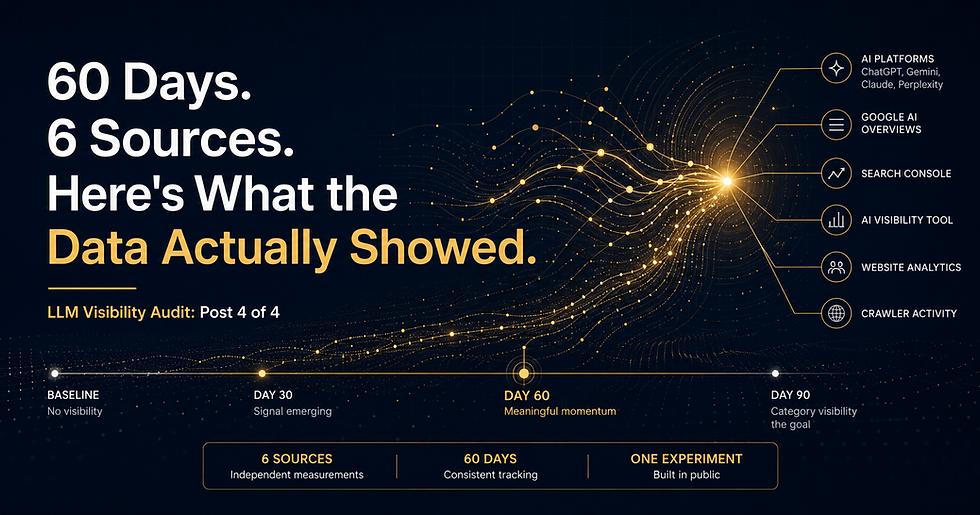
This is Post 4 in a series documenting a live LLM visibility audit on my own brand, NextWise Studio. Post 1 covered the baseline. Post 2 covered what I changed and why. Post 3 covered the 30-day results. This post covers Day 60.
Sixty days ago, I started asking a question I think more brands should be asking:
If someone searches for what I do in an AI tool, do they find me?
At baseline, the answer was no. Not for category searches — the kind where someone doesn't already know my name.
I made a set of deliberate changes, measured the results at Day 30, kept building, and now I'm back with the Day 60 data. Here's what it showed.
What I measured
Same six sources as before. Manual prompts across ChatGPT, Perplexity, Claude, and Google AI Overviews. Google Search Console. A third-party AI visibility tool. Website analytics. AI crawler activity. And the Gen AI visibility report from my site platform.
Six sources. Sixty days. Here's what each one showed.
What moved
Google AI Overviews is now my strongest signal.
At baseline, Google AI Overviews returned basic brand information. At Day 60, it returned a comprehensive, multi-source response with sidebar links to my website, LinkedIn, FAQ page, How I Help page, and Crunchbase profile.
That's a meaningful jump, and I think it reflects the structured data work, directory listings, and content publishing that happened across the 60-day window.
All four AI crawlers visited my site within the last three days.
ChatGPT, Gemini, Perplexity, and Claude all crawled nextwisestudio.com within 72 hours of this measurement.
That's the strongest crawler activity of the entire experiment.
There's another encouraging signal as well. AI crawler traffic increased 46.3% over the 60-day measurement window, growing from 2,041 hits to 2,986 hits (+945) compared to the previous 60 days.
While crawler activity doesn't guarantee visibility, it does suggest AI systems are discovering and revisiting the site more frequently as additional content and entity signals are published.
That's another indication that the foundational work is beginning to compound.
The FAQ page — specifically designed with LLM visibility in mind — is now appearing among the top pages being queried by AI systems.
ChatGPT queries referencing my site are up 18% from the Day 30 period.
The trend that started at Day 30 is continuing. More people are asking ChatGPT something that leads them to my site.
The FAQ page — specifically designed with LLM visibility in mind — is now appearing in the top pages being queried by AI systems.
When I appear, I appear first.
On a third-party AI visibility tool, my average rank when appearing is 1.00 across ChatGPT, Gemini, and Google AI Overview.
That means every time the brand surfaces, it surfaces in the first position.
Share of voice is now equal to ChatGPT the platform and ahead of several established firms.
The LLM Visibility Audit topic is now showing up.
At Day 30, I had zero category topic appearances.
At Day 60, NextWise Studio is appearing in AI-generated answers for "LLM Visibility Audit"
queries, with 50% visibility and ranked first.
That's the first real movement from brand recognition toward category association.
Two prompts are ranking first across all three platforms.
"How does NextWise Studio's LLM visibility audit compare to other providers?" returns NextWise Studio at rank 1 on ChatGPT, Gemini, and Google AI Overview simultaneously, with 100% visibility.
"NextWise Studio vs other marketing consultants specializing in AI transformation: which is better?" returns rank 1 on ChatGPT and Google AI Overview, with NextWise Studio mentioned alongside McKinsey, Deloitte, Accenture, and BCG.
What didn't move
Broad national category visibility is still zero.
If someone asks, "Who are the best AI marketing consultants for mid-size brands?" without knowing my name, I don't appear. Not yet.
This was always going to be a Day 90 story, and I still believe that.
The brands appearing in those results have years of citations and authority behind them. Sixty days isn't enough to close that gap.
Claude is still inconsistent.
Despite completing a schema sameAs update that connected my website directly to my Wikidata entity in May, Claude still doesn't consistently surface me as the founder of NextWise Studio.
It sometimes pulls colleague recommendations from LinkedIn. Sometimes it surfaces the Romanian company with a similar name. Sometimes it returns accurate information.
The signal is there, but it hasn't stabilized.
The naming collision persists.
A significant portion of my Google Search Console impressions are driven by searches for NEXTWISE AI Systems Studio, a Romanian company with a similar name that launched earlier this year.
My actual branded impressions are strong, averaging position 4, but the collision remains the biggest source of noise in the data.
The most interesting finding of the entire experiment
When I ran the prompt:
"Marketing consultant for LLM visibility and AI search"
Claude didn't give me a list of consultants.
It offered to be my consultant.
It presented itself as an interactive LLM visibility advisor and offered to answer questions about why brands get cited, how to structure content, and how to measure AI visibility.
That told me something important.
The category of "independent LLM visibility consultant" is still taking shape. The tools that are supposed to recommend people in this space are sometimes stepping in to fill the gap themselves.
I don't see that as a failure. I see it as evidence that the category itself is still being defined.
And I think that's interesting.
This experiment is one small part of building that category.
My belief is that the practitioners who document their methodology publicly, with real data, before the category becomes crowded are the ones most likely to become part of the learned signal over time.
What I learned about measuring this at Day 60
Brand visibility and category visibility are two different things, and they move on different timelines.
Brand visibility — whether AI tools accurately describe who you are and what you do — can move in weeks with the right structural changes.
The schema updates, the Wikidata entry, the directory listings, and the Crunchbase profile all contributed to meaningful improvement in how ChatGPT and Google AI Overviews represent this brand.
Category visibility — whether AI tools surface you when someone searches for what you do without knowing your name — takes longer.
It follows citation density, not just technical optimization.
The more corroborating mentions exist across trusted third-party sources, the more likely you are to appear.
That work is ongoing.
And there's a third layer that nobody talks about enough: category definition.
Before a brand can be cited for a category, the category itself has to be defined well enough in AI systems to generate consistent recommendations.
For LLM visibility consulting, I think that definition is still being written.
What comes next
Day 90 publishes July 20.
Between now and then, the priority is citation density — more community presence, more third-party mentions, and one well-placed publication pitch.
The May interventions — schema update, Crunchbase, Bay Area copy, and entity disambiguation — haven't had enough time to fully compound yet.
Day 90 will be the first true measurement of their impact.
I'm still taking on a small number of brands to run this audit alongside my own. If you're curious what your baseline looks like, get in touch.
Day 90 report publishes July 20, 2026.


Comments